

— August 3, 2026

Introduction
All that glitters is not gold. Just ask my client.
When my client, a Waltham attorney, reported to her local police that she had been victimized by a scam, the police undertook an investigation. They combed through FBI records to see if the suspected perpetrators had pulled off a similar heist on other attorneys. The police discovered twenty other reported instances of the same perpetrators scamming other attorneys with a similar scheme. The average payday for the perpetrators was $100,000. One attorney lost over $500,000 in the scam. And this is only what was reported to the FBI. For every attorney who reported being scammed, how many were too embarrassed to admit to their loss?
What’s the scam? How is it that attorneys, the risk-averse, conservative guardians of capital, fall for scams? What can you do so that you do not unwittingly become a pawn in a Ponzi scheme? This article will point out some telltale signs of a scam so you do not become the twenty-first attorney to file a report with the FBI.
What’s the Scam
The scam perpetrated on attorneys goes something like this. An attorney is contacted by the scammers who request the attorney to perform some professional service on their behalf. Perhaps they ask that the attorney draft a contract involving a fake company. Or, in the case of my client, they requested my client to conduct an arbitration proceeding involving their fake company and another fake company they were allegedly having a dispute with. The scammers then pay their target attorney for his/her services. All of which seems above board.
Then the scammers weave their web to entrap the victim attorney. Shortly after initially engaging the attorney, the scammers add a layer to their requested services. The additional request seems innocuous, but in truth, it is a Trojan horse of deceit. The additional request goes something like this. The scammers want to give the attorney money to hold in escrow – a lot of money. It is a lot of money because this is the amount of money the attorney will be scammed out of. The reason the scammers ask the attorney to hold the money in escrow can vary. Here’s one scenario. In my client’s case, the scammers told my client that their arbitration agreement required the amount of money in dispute to be placed in escrow (perhaps that should have raised some eyebrows). Here’s a second scenario. The scammers retain you to negotiate the purchase of heavy equipment. Then they give you $100,000 to hold in escrow to be used to purchase the equipment. The point is that you are holding money that does not belong to you, but is property of the scammers. In my client’s case, the scammers sent $40,000 to be held in escrow in the re-assuring form a bank check (perhaps another Trojan horse as you will find out). My client deposited the money in her client’s fund account.
If it doesn’t strike you as unusual to now be holding a large sum of money in escrow for parties you did not know existed a week ago, what occurs next certainly should alert you to the possibility of abnormality. And this is key to the scam. Almost immediately after receiving the escrowed funds, my client was asked to remit the escrowed funds to a third party. Does the reason matter? Probably not, because the funds are not funds belonging to the attorney. They are the client’s funds, and the attorney, as escrow agent, is simply disbursing the funds as directed by her client. But there will be pressure to make the disbursement fast. Not to be duped (or so she thought), my client did as any cautious attorney would do, and refused to disburse the funds immediately. Instead, my client, assuming such caution would protect her (which, spoiler alert, it did not), insisted on waiting for the check she deposited to clear, before issuing a check out of her client’s fund account to the third party. Reluctantly (probably part of a well-rehearsed script) the scammers agreed to this temporary pause, but insisted that my client issue the check the day the funds cleared. Which my client did. The same day her bank indicated that the escrowed funds had been converted to available funds, she wrote a check to the third party for the full amount of the escrowed funds.
And then the fan became covered with brown material.
About a week after writing that check from her client’s fund account, her bank notified her that the check she had deposited from the scammers, the very same check the bank had indicated had cleared, was in fact dishonored by the issuing bank. Those funds which had been deposited into her client’s fund account, and which the bank had characterized one week ago as “available funds” were now being withdrawn by her bank. Like my client, you might ask yourself (if you are a fan of the Talking Heads), wait a second, can a bank take back funds that it has told you have cleared? Is that legal? Short answer, yes, thanks to the Uniform Commercial Code (the “UCC”). Then you might ask yourself, what recourse do I have? Can I reach out to my scammy clients to get them to give me another check? Short answer is sure you can reach out to your scammy clients, if you want to waste your time in an exercise in futility. Because as you should have anticipated from the moment they asked you, a stranger, to hold $40,000 in escrow, they are not real clients, and it was not real money they gave you to deposit. Lastly, you might ask yourself, what about the fact this is coming out of my client’s fund account, is that bad? Short answer, is that it is very bad that this involves your client’s fund account, and unless you want to engage in friendly, or not so friendly, banter with the Board of Bar Overseers, you better restore those funds to your client’s fund account pronto. Which means taking money from your personal account (real money, not fake money) and putting it into your client’s fund account, which you probably don’t want to do, and perhaps, may not have sufficient personal funds to cover.
To wit, the fan is now covered with brown material.
How Can the Scammers Get Away with this?
Whether knowingly or not, the scammers take advantage of a complex set of laws that provide a safety net for banks. As discussed below, because banks are allowed to take back funds they have deposited into their own customer’s account, recipients of checks are misled to believe they have funds permanently, when in fact, the funds in their bank account are subject to a caveat the account holder is unaware of.
My client was reassured when she received a “bank check” from her scammy clients. What my client did not know (nor did her bank know initially) was that the bank check was a forgery As in the movie The Sting, in this type of scam, nothing is what it appears to be. The bank check my client deposited sort of looked like a bona fide bank check from an out-of-state institution (make a note of the out-of-state), but it was a fake check. But it was good enough so that when she deposited the check with her bank, it passed initial muster and was not flagged as fraudulent from the get-go. Score one for the scammers.
This is where the first of our arcane banking laws come into play, probably intended to benefit the public, but with a consequential kicker that, in the long run, harms innocent depositors like my client. In 1987 Congress enacted the Expedited Funds Availability Act. In 2003, the Board of Governors of the Federal Reserve System promulgated regulations known as Check Clearing for the 21st Century, or Regulation CC. The purpose of these regulations was to allow banks to more rapidly clear checks by use of electronic images of the checks, instead of exchanging physical paper checks with each other. Which seems like a good thing. However, one consequence of Regulation CC was that it mandated certain time limits within which a depositor bank had to tell its customer whether a deposited check was funded or not by the issuing bank. And for bank checks, like the check my client deposited, a depositor bank had to declare within 24 hours if it was funded or not. Given the statutory protection a bank has under the UCC, described below, a bank suffers no adverse consequence if it declares a deposited bank check as being sufficiently funded by the issuing bank. Which is what my client’s bank did when my client deposited the fake bank check for $40,000 into her account. One day after my client deposited that check, the bank classified the deposited check as “cleared” and increased the available funds in her client’s fund account by the amount of the deposited bank check.
And then one week later, poof, the money was gone from my client’s bank account. The bank withdrew the $40,000 it had previously credited to her account, without informing her of this subsequent withdrawal. Though my client did receive a letter from her bank one week (not one day!) later informing her of the withdrawal or “charge back” as the bank called it. All of which was permissible, as long as the bank followed procedures laid out in the UCC.
The Role of the UCC
Not surprisingly, the UCC (a/k/a the Unfair Commercial Code) provides the legal underpinnings that allow a bank to issue a charge back against a customer’s account after it has credited funds into that account. Section 4-214 of the UCC (Mass. Gen. Law ch. 106, § 4-214), is titled, Right of Charge-Back or Refund; Liability of Collecting Bank; Return of Item. The UCC allows a collecting bank (i.e. the depositor’s bank) to issue a charge back (i.e. withdraw funds) from a customer’s account, if it provides notice to its customer no later than midnight of the next banking day of its charge back. The reason the UCC permits a bank to do this, is that according to the UCC, when a bank credits its customer with proceeds from a deposited check, that credit is a “provisional settlement.” Since it is merely “provisional” it can be unsettled by a charge back, if the bank subsequently learns the funds it provisionally deposited into its customer’s account don’t really exist. Is calling a deposit which has been cleared by a bank a “provisional settlement” an example of digital prestidigitation? All depends whom you talk to. Talk to a depositor and it sure is. Talk to a bank, or more accurately, a bank’s lawyer, and it certainly isn’t, it’s obeying the law.
In other words, Section 4-214 of the UCC in conjunction with Regulation CC of the Expedited Funds Act encourage a bank to prematurely classify a check as cleared and credit its customer’s account with funds because later it can withdraw those funds without liability. So why should a bank be cautious at the front end, if it can back out of its commitment on the rear end without liability?
Who suffers as a consequence of this lack of caution? The bank’s customers, like my scammed client. She thought she was being prudent by refusing to issue a check from her client’s fund account until her bank had cleared the deposited check. Little did she know (now she knows) that what has cleared can be uncleared later by a bank. And what about the fact that she did not receive notice of the bank’s charge back until 7 days after the charge back took place? Again, if you are my client, you blame the UCC. If you are the bank, you credit the UCC. Because Section 4-214 of the UCC states that once a bank learns of facts that cause it to issue a charge back, it only has to provide notice of the charge back to its customer by midnight of the next business day. It doesn’t say “reasonable” notice or “expedited” notice. Just notice. Which my client’s bank did when it sent her a letter by snail mail informing her of the charge back. For sure the bank had my client’s telephone number, email address, and instant message account, but it chose not to use any of those more instant communication channels because, under the UCC, it did not have to. It only had to buy a stamp to notify her.
The Role of the Board of Bar Overseers
Massachusetts Rules of Professional Conduct 1.15 regulates client funds accounts maintained by Massachusetts attorneys. These accounts are commonly called IOLTA accounts (“Interest On Lawyers’ Trust Accounts”). Sub-section (h) of Rule 1.15 governs what happens when a lawyer issues a check from his/her IOTLA account that is dishonored. It is not a good thing. In accordance with Rule 1.15 a bank that is authorized by the Board of Bar Overseers (“BBO”) to maintain IOLTA accounts must agree to notify the BBO whenever a check from an IOLTA account is dishonored by the issuing bank. When the BBO is notified, it then contacts the issuing attorney who has to explain to the BBO the circumstances that caused the dishonor. Will a Pandora’s Box of messy accounting practices have to be disclosed to the BBO? This is a conversation most attorneys would prefer to avoid by scheduling a conflicting root canal. Imagine the delight of our scammers (assuming they are aware of such things) that not only has their scam netted them $40,000, but in addition, their target prey is now telling the BBO how her accounting practices have allowed for such an unfunded check to be issued. Talk about being kicked while you are already writhing on the ground!
Attorney scam attacks are so common, in 2015 the New York City Bar Association issued a formal ethical position paper on what a lawyer should do when victimized by a scam. Formal Opinion 2015-3 presented a list of red flags that should alert an attorney to the possibility that a potential client is part of a scam. The opinion went so far as to say that when any of the red flags are present, an attorney “should conduct a reasonable investigation to ascertain that the email sender is a legitimate prospective client.” This would seem to place an affirmative obligation on the part of an attorney to investigate a suspicious engagement. In other words, an attorney cannot plead ignorance.
How to Protect Yourself
Hindsight is 20/20. As my client described this scenario to me, it was obvious to both her and me, that she was being scammed. But more importantly, she realized there were telltale signs she ignored or was ignorant of, that could have alerted her to the fact that she was in the midst of a scam. Here are some of those signs:
- Be suspicious of anyone who wants to give you money before they have a proven relationship with you;
- Be suspicious of getting involved in a complicated transaction that prior lawyers were not involved in. If you are approached to assist a transaction in mid-stream, ask to speak to prior counsel; if there is no prior counsel, ask why;
- Be suspicious if your client suddenly pressures you to do something in a rush. The scammers want to get in and out as fast as possible; if they ask you to do something that seems precipitous, it probably is, and you should press pause before continuing;
- Pay attention to details. Almost without fail, scammers will give you documents that have typos in them or sections that don’t make sense. Ask yourself, why are these documents so sloppy;
- Pay attention to email addresses. Frequently scammers will identify themselves as the CEO or other executive of a corporation. But their email address will be a gmail address, not a .com address. That is a tell. If they were truly part of an organization, chances are that organization would have its own email domain. A gmail address is typical of a personal account not a corporate account. Fyi, an aol email account is suspicious but not as bad as a gmail account. Typically aol email account users are older people who were early adopters of email and obtained their initial email address through America OnLine (fyi, my gen Z editor did not know what AOL stood for). If that fits the profile of the client you are talking to, that may explain the lack of a .com email address. But if it doesn’t, then be suspicious of an aol email address. Further, you can learn information by examining the metadata appended to an email, like the location of the sender’s email server. If you don’t know how to do this, consult a technology professional;
- Be suspicious of clients that want to give you paper checks. If a client requests payment from you by paper check and not by wire or other electronic means, this may be because they are trying to fall outside the scope of Regulation E of the Electronic Funds Transfer Act. In general, Regulation E limits a person’s liability to $50 if that person is defrauded via an electronic transfer. However, Regulation E offers no protection where the transaction is conducted by conventional paper checks;
- Don’t be naïve or take short cuts. Conduct the due diligence you would advise yourself to do if you were your own client. If someone tells you they are the CEO of Acme Corporation in Ohio, then google Acme Corporation in Ohio to see if it exists. Google the names of all the parties involved in the transaction. Scammers are not dumb and they are getting more sophisticated by the day. It may not be enough to merely verify that Acme Corporation exists. If it exists, call it up to verify if your client is its CEO;
- Be suspicious of the foreign entity that needs local counsel to consummate a local transaction. That is a very common opening line for a scam. If the scenario involves local entities, contact those entities to make sure the transaction is legitimate. I once did this to verify if a transaction was legit. It involved a hospital in Worcester. When I contacted the Worcester hospital, it was aware that its name was being used for such a scam, but for reputational reasons, it refused to issue public notice about the use of its name for illegitimate purposes. So much for netiquette;
- If you are suspicious about the authenticity of a new client, do not limit communications to email. Talk to the client. Better yet, video conference with the client. Scammers do not like to be seen. If they are reluctant to video conference (I am assuming your potential client is remote, otherwise insist on an in-person interview), then don’t do business with them. Additionally, ask for references. Do your homework; and
- If none of the above work, and you are the victim of scam, do as my client did and report the scam to the police. Most likely the police will do nothing, but sometimes you get lucky, like my client got lucky, when the Waltham police department conducted a thorough investigation into the scam, going so far as to subpoena documents from the bank to track the scammer’s activity. Using documents the police obtained from the bank and information the police discovered about the scammers, my client successfully recovered all of her money from the bank.
Regardless of your diligence, mistakes happen. Scammers are getting more and more sophisticated. If scammers were not sophisticated, the Waltham police department would not have discovered 20 incidents reported to the FBI of attorneys being scammed. Depending on your practice, if you believe you are vulnerable to such a scam, then get insurance. Especially if you, like my client, have a large residual amount of funds in your client’s fund account, you should obtain protection. Even though the check she deposited from the scammers was a fake check, the check she wrote to the scammers was honored because it was paid out of other funds in her client’s fund account. So think of insurance as protecting not your assets, but your clients’ assets. Otherwise you become the de facto insurer of your client’s funds. Not just any ordinary insurance, you will need insurance designed to protect you from fraud. As my client discovered when she tried to obtain insurance coverage for her loss, conventional business insurance and legal malpractice do not provide protection from scams. Ask your agent about insurance to cover loss from social engineering fraud.
Conclusion
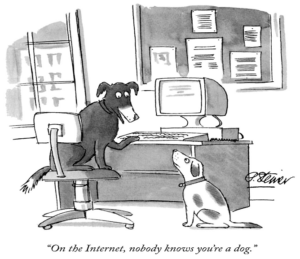
Don’t be fooled by a dog.
Copyright 2026, Peter Kelman, Esq. All rights reserved.
Peter Kelman is a practicing attorney specializing in technology issues. Against the advice of those who knew better, he used google ad words to promote his practice during the pandemic when he thought office visits were a thing of the past. As a result of that advertising effort, attorney Kelman has been on the receiving end of every scam targeting attorneys the world has ever known. Attorney Kelman represented the victim described in this article and was successful in obtaining a very favorable settlement from his client’s bank.